
A few months ago, my friend, Chebet, would call me and somewhere in the course of our conversation, say: "There is a guy I would like you to meet. He is a mountaineer. He climbs mountains even in other countries. I would like you to meet him because he is as crazy as you."
Naturally, I had questions. What do you mean he is as crazy as me?
"Because you are the only other person I know who gets as excited about hiking as he does."
I understood Chebet to be referring to a few months back when I had invited her to a Ngong Hills hike. That trail had shown her 'some dust' as Kenyans often put it, though I recall she did quite well that Saturday.
A few weeks later, I met Chebet at Jaffery's Sports Club in Lavington (Jaffery's), where I occasionally run or walk, depending on whether I have company or not. She did not seem to want to walk. Let's not consider whether she wanted to run because for the short period that I have known her, I have never seen her run. Maybe she does. One time, she might have told me she tackled a kilometre nonstop. Or was it 900 metres?
There is a café at Jaffery's where, on some Thursdays, we share a cup of coffee across conversations after our walks or runs. Walks especially. We had some coffee and this 'crazy guy' came up in our conversation again. His name is Kiprono, she said. He hosts a podcast called Baada Ya Summit. You would love meeting him, she concluded.
Baada Ya Summit podcast, I thought. Any hiker would have an idea of what that name was all about, I told myself. Now, I was excited to meet this guy.
Baada Ya Summit Podcast
5th August 2026. This was the day I would finally meet Kiprono at an event for his podcast, which focused on hiking in Namibia, Ethiopia and Mauritius. I showed up in a suit because, occasionally, I am the son of the dramatic, if not all the time.
There were three presenters that day, all hikers or mountaineers. I must say that at this point I was not very familiar with the phrase 'mountaineer'. I am still not very familiar with that world even as I pen down this experience. Kiprono took us through his hiking experience in Namibia, while the other two presenters shared fascinating stories of trail exploits from Ethiopia and Mauritius. And my mind just went — so Kenyans have hiked Kenya too much to the point that they now go to other countries to hike? And by other countries I don't mean just doing Sipi Falls in Uganda or Mt Longido in Tanzania. I mean going to Namibia, for example, or Morocco or wherever else Kenyans have gone? This is my kind of stuff, I thought. Fascinating, relatable stories, I told my inner child.
Three minutes into Kiprono's story of how he conquered Brandberg Mountain in Namibia, I was ready to order a pizza and just lock in.
It was after that event that I learnt Kiprono was planning a walk he called the "All Nairobi Bypasses Walk".
"What is the distance?" I asked.
"101 kilometres."
"When?"
"We are doing it on 22nd and 23rd August 2026."
"Good stuff. Count me in."
He promised to share the details soon. About two weeks passed and this man had not shared any details about the walk. Was all this just a conversation in thin air, I wondered, or was I dealing with just a professional hiker who saw no point in overpreparing?
Then, on 17th August 2026, a Monday, Kiprono added me to a WhatsApp group called Nairobi All Bypasses Hike. My mind, in Atwoli's voice, went: 'Alaaah!' This thing was on.
It was all good in the beginning
My Strava indicates that I did absolutely nothing the week before the walk. Saturday came. We were supposed to be four walkers. Luckily for her, the fourth walker, Wamaitha, did not wake up. We called her and in a voice that seemed defeated by sleep, she said: "Nyinyi endeni." And so the three of us went.
We left Ngong Road Forest, Miotoni Block, at 6:32am with one goal in mind: to complete a full circuit around Nairobi using all four bypasses and return to the same point within two days. The route would take us along the Southern Bypass towards Gitaru, onto the Western Bypass through Wangige and Ndenderu to Ruaka, then across the Northern Bypass to Ruiru. From there, we would follow the Eastern Bypass through Kamakis, Ruai and Utawala to Mombasa Road before rejoining the Southern Bypass and returning to Miotoni.
Day one would end at Kamakis after 54.47 kilometres. Day two would cover the remaining 47.47 kilometres back to Miotoni. On foot. Step by step.
We were still chatty at this point. Lots of stories and laughs. There were stories about how I was turning 30 in September, apparently making me a Gen Z, which I am not. There were stories about how Khaleesi (the other walker) and Kiprono had conquered some truly great trails, including something they called the Cha Muhimu Traverse across the Aberdares. Ninety-four kilometres. Three nights. Four days. Five summits: Satima, Table Mountain, Rurimeria, Kinangop and Elephant Hill. It is Kiprono that had named it Cha Muhimu Traverse. I thought about that name for a while. It is a play on the familiar Kenyan phrase Bora Uhai, meaning 'as long as there is life.' Cha Muhimu in this case was essentially, as long as we summit the five mountains in the Aberdares. How you get there, what happens to you along the way and perhaps even the condition in which you emerge are secondary matters. This man was truly crazy.
They did this in January 2025 and I am reliably informed that they have never debriefed since. That should probably tell you everything you need to know about the experience.
Wamaitha, by the way — yes, the same Wamaitha who had been defeated by sleep that morning — had also attempted Cha Muhimu. She had made it to within about 84km. So perhaps sleep had merely saved her from another questionable life decision.
It was all good in the beginning, and we thank God.
We had a good support team checking on us in a car: a driver and a security officer. In no time we approached and passed Kikuyu. We were still energetic when we reached Two Rivers, on the left wing, where we took a break. This was around 12:38pm. This was 30km in, and we had 24km remaining until our resting point for the day (Kamakis, on the upper side).
You would think the remaining 24km would be easier. No, my friend. Each step was punctuated with "Ni fire, si fire?" — but in Riggy G's voice.
The Sound of Silence
Have I told you about the silence? After our break at Two Rivers, the rest of the journey was punctuated with silence. We only spoke occasionally, such as when we stopped for some maji ya mnazi or when I stopped to buy akala from a Maasai vendor.
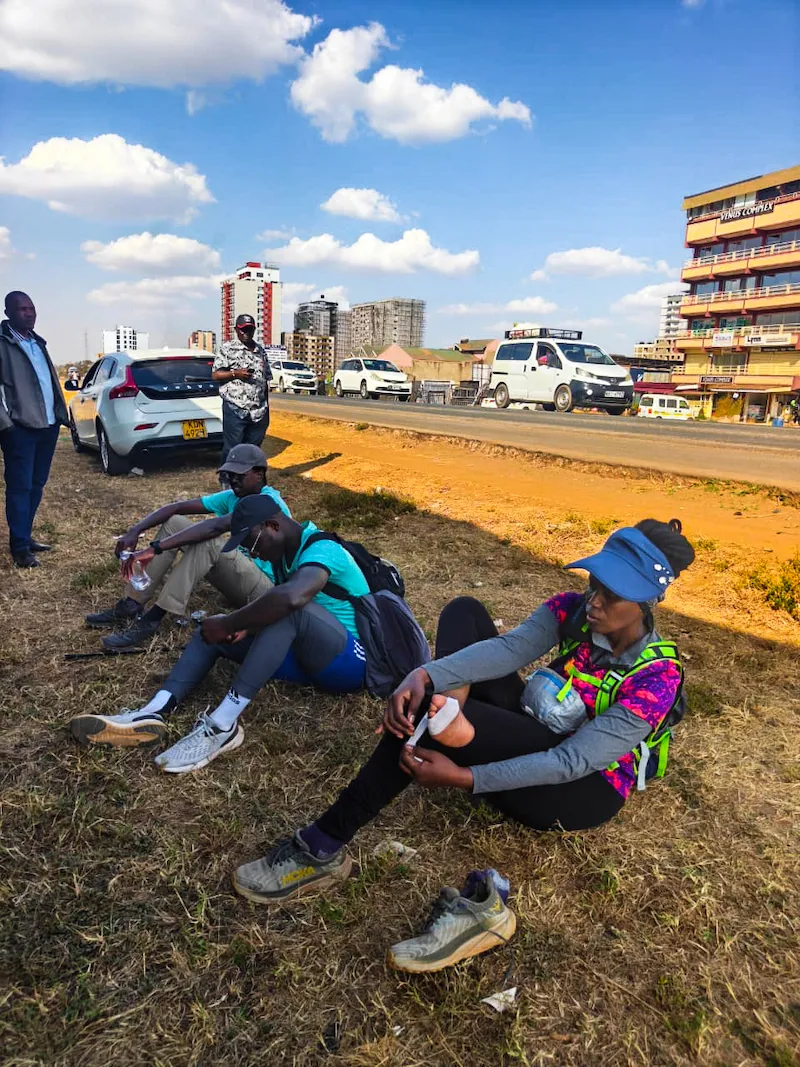
A real conversation sparked about 10km after Two Rivers. It was a conversation about blisters. One of us said, "I can feel a section of my foot getting warm."
"Warm?" I asked innocently. "What do you mean?"
"The warmth means a blister is emerging."
That was when another walker said, "I actually think I have two so far." And we stood for about 30 seconds to give him a standing ovation.
Their ability to walk had not disappeared. The growing number of blisters simply forced them to slow down a bit. They still had it in them to keep going. It was at this point that I started to appreciate that this was not merely a walk. It was a hike. A serious one, for that matter.
It was also around this time that I started asking myself: what exactly are we doing walking on the road?
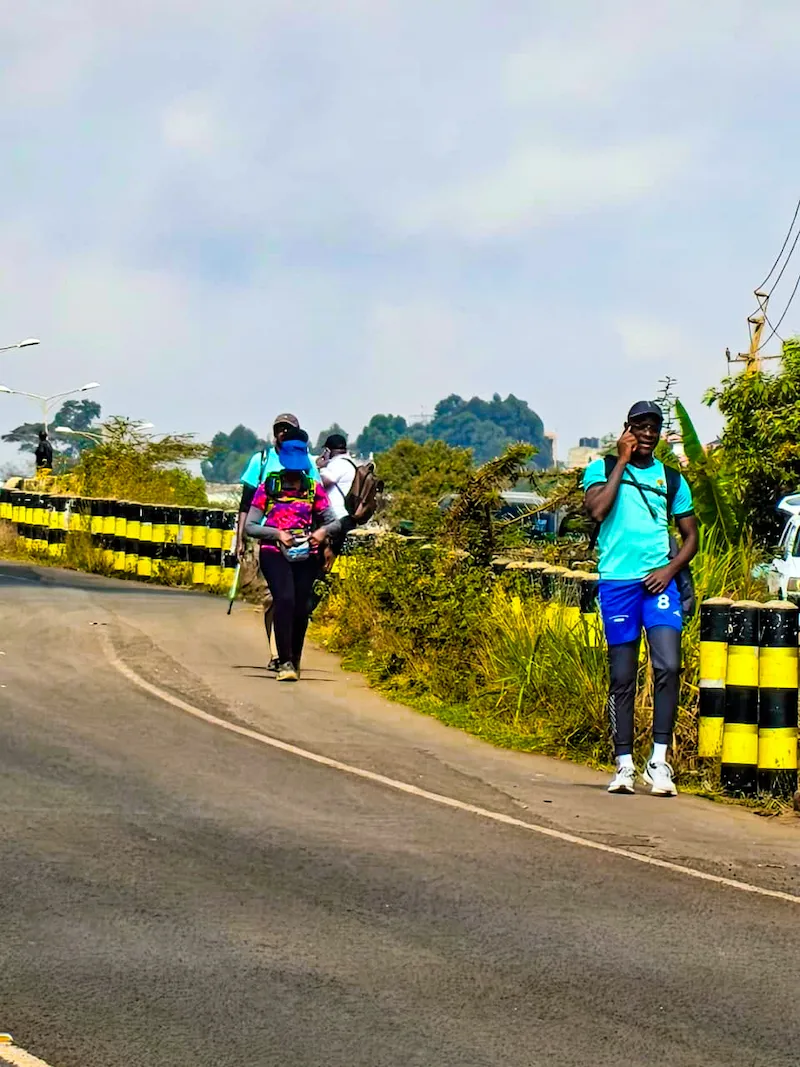
I should mention that, at around kilometre 15, we had crossed paths with some walkers who told us they had begun their journey at 8:00pm the previous evening and were already on their 73rd kilometre. You could tell they were suffering more than us by the way they were walking. But when they spoke — because we were screaming at each other at the top of our voices across a wide road — you could tell their will was awake and their spirit higher than Bob Marley. The thought of them kept me moving. So did the music in my ears. Yes. After the break at Two Rivers, I understood that music would have to push me for the remainder of the day.
The Longest Six Kilometres of Our Lives
We kept pushing. The presence of blisters on my friends' feet did not stop them. They slowed down, but they kept moving forward. We were now talking about how we should have brought different shoes and socks to the hike. Perhaps we had underestimated this walk. One thing was, however, clear: we were moving forward.
The last six kilometres of the walk were longer than the River Nile. Why, you ask? At kilometre 48, you begin to wonder whether you will ever reach the 50km mark. Those two kilometres took approximately two years to cover.
Kiprono called a small conference meeting of the three of us and informed us of a well-thought-out decision — he would finish his day's walk at the 50km mark. Khaleesi and I then called another high-level consultative inter partes meeting and decided that we would walk all the way.
What followed was the longest 4km of our lives. The road ahead was straight, but we could not understand why it was taking so long to reach the finish line. Darkness was now on the horizon. Occasionally, I thought about Kiprono, who was now sitting in the car. Was he laughing at our plight? I mean, if it were me, I would laugh too, just a little.
By the time we reached the hotel, we were extremely exhausted. We could barely move our legs. You must be familiar with the phrase 'not all movement is locomotion'. That was our situation. We struggled into the lift, snailed our way to the reception and were shown to our rooms. The rooms were good. Fancy, even. But they could not wash away the day we had endured.
The Lower Body Was the Storyteller
The thing about walking on the road for a very long distance is that the arms know nothing about it. Even as they write this story, they cannot fully appreciate the solemnity and seriousness of walking 101km. I suspect it is actually the legs dictating to the arms what to put down because this story really belongs to the lower body. The upper body was simply making the legs' work more difficult.
The lungs could not understand the complaint either. There had been no serious panting and almost no sweating. When you walk, it is not actually you walking, but the legs. That is one reason I prefer hiking up a mountain. On a mountain, you occasionally get to walk on all fours, pant your lungs out and almost sweat your haemoglobin out. That was not the case with this road hike.
When I reached my room, I sat down for about 20 minutes with one question on my mind: What the hell was that? I then took a cold shower to try to numb the nerves in my legs. Did that work? Your guess is as good as mine.
The Repercussions of War
After the shower, I called my people to find out where they were. They told me they were heading towards the lounge and restaurant section. This required going down one flight of stairs to the sixth floor and then taking a lift to the fourth floor. I had assumed they would have showered by then. The thing about assumptions is that that is all they are — assumptions.
They were still wearing the day's regalia, although the war itself was far behind us. We were now dealing with its repercussions. They could not walk straight. Neither could I. Occasionally, we held on to a chair or a wall. When there was nothing to hold on to, we clutched onto life itself.
We sat down and Kiprono suggested ordering one kilogram of mbuzi. I protested. Given the day we had experienced, I felt I could finish a kilogram alone. Food therefore came in plenty.
Some excellent stories would naturally emerge. I could not help but realise that I was sitting among great hikers and mountaineers. I was merely a teenager in this field, while these two were in their prime. They told stories about how they had conquered the Rwenzori Mountains and about a friend who had summited there wearing shorts despite the extreme cold. Who else do you know who likes hiking in shorts? These were my kind of stories. I hoped I would be able to tell stories like these sooner rather than later.
Kiprono was shocked when I told him I had never been to Mt Kenya. He almost assembled the required gear, found me a vehicle and appointed a guide on the spot.
He then asked this beautiful question: "Are you guys going to walk tomorrow?"
I looked at Khaleesi and answered first. "I am not a gambling man. And neither do I like to speculate. As at now, I do not know what my body is up to. The Bible also says that we should not worry about tomorrow's troubles. Let us see how this body will be tomorrow. As things stand, I will not be able to walk."
Khaleesi gave me a sharp look. "You have changed your mind already? We agreed we are doing this again tomorrow."
This was true. We had agreed, at least by word of mouth. But had the mouth done any walking so far? Or maybe the mouth would do a few kilometres the next morning? My legs wanted to know.
When we first sat down to eat, I had gone back upstairs to get a jacket. I struggled terribly. I even wondered what had changed. It had not been that bad when we arrived at the hotel. That journey upstairs almost convinced me that I could not walk the following day. This is the reason I doubted I could do it the next day.
Do you know why Khaleesi was certain she would walk again? First, she is an exceptionally determined person. Even with more than four blisters, she kept moving. She kept talking of blisters as if they just come and go. Earlier, she had covered some of them with tape and announced: "I feel much better. Let us keep going." Second, she had not stood up since sitting down to eat. She did not yet know that the body was relaxing — and changing. Changing faster than the weather on Elephant Hill. She discovered that when we stood up to go to bed.
We promised each other that we would see what tomorrow looked like. Then we bid each other goodnight.
The Morning After 54.47 Kilometres
I do not remember falling asleep, which means it must have been peaceful. When I woke up at 5:45am, I felt considerably better. Then I remembered that I was still lying flat in bed. I was afraid of sitting up or standing and discovering that my situation was dire.
Eventually, I stood and moved around the room. I quickly made a finding: I could walk that Sunday.
I did not know whether I could walk the entire 47km, but I knew that I could walk. So, I prepared. This means I played some slow music, took a cold shower, put on my gear and called Kiprono. He told me they were already at the reception. I went down the stairs, took the lift further down, collected breakfast with them and headed outside to the car. We saved the breakfast for later. This time, I decided not to carry my hydration bag as that would make me lighter. It remained in the support car.
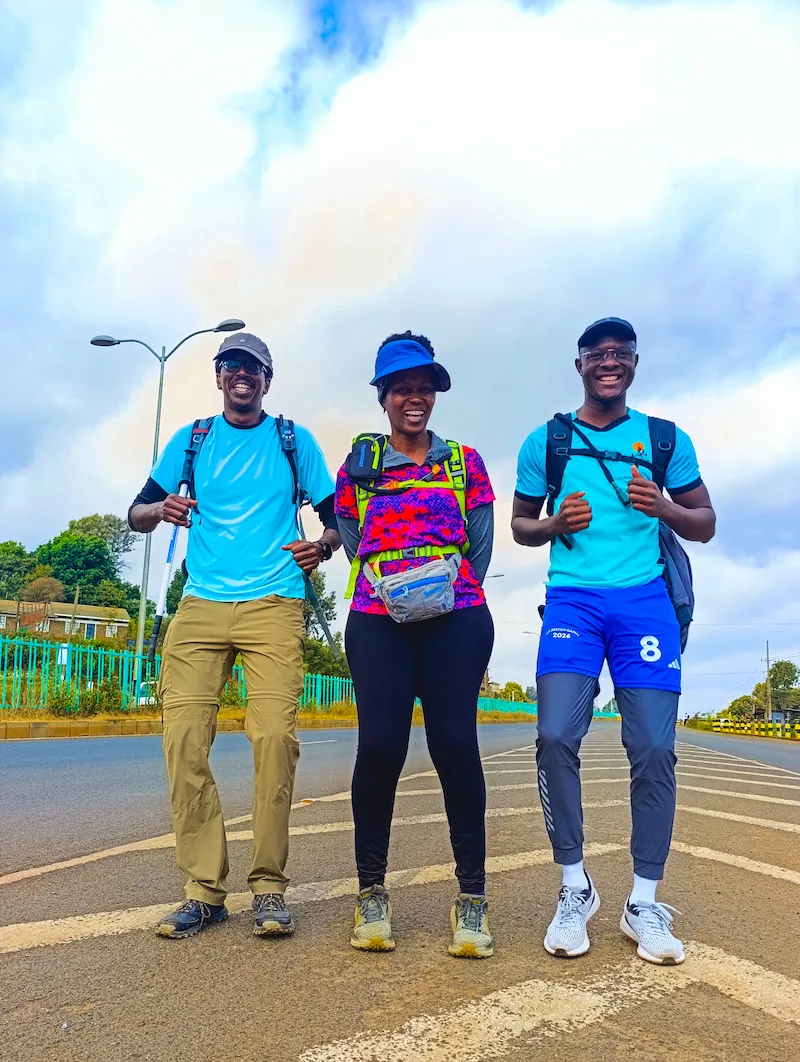
Kiprono was not walking today. He had made it categorically clear the previous day. As clear as the day that was ahead of us, if I might add. Khaleesi was. Daniel, who had been the driver yesterday, decided to join us. He had called in his friend to drive the car. We were therefore still a group of three walkers.
As Sunday's route was "only" 47km, compared with Saturday's 54km, we agreed to proceed at a slower pace. We started at 7:02am from Kamakis where we had spent the evening. About 700 metres into the hike, I realised that if I continued at that slower pace, I would not finish the walk. You know how the legs can measure their remaining strength and communicate their findings to the brain? I had to finish this challenge, I thought to myself. And with that thought, I took off.
The Last Check-In
The support car checked on me three or four times. The last check-in came after I reached Utawala at 9:29am. It was also the first time I drank water that day. My hydration bag had remained in the car.
Kiprono asked me to take 'my things' because it would be a while before the team checked on me again. He estimated about an hour and a half. There was a reason for this. As we had split into two groups, the support car had to check on both groups. After driving up to me, they would ordinarily wait for the team behind me to get to the car before driving forward to find me again. During the three or four check-ins, my pace had gradually increased, widening the distance between the two groups. I therefore understood what Kiprono meant. The delay before the next check-in would be directly occasioned by my own speed.
The security officer asked whether I wanted tea. I said no and took off again from Utawala. Little did I know that this would be the final check-in. The next time I saw the team was at the end of the journey.
When the legs could not walk, they ran. I was moving at a fast speed to remain focused and ensure that my legs would not give up. At some point, my legs began to feel heavy. To cure this, I decided to jog for a while so that I could "activate them". A runner will always invent an excuse to run for sure. I jogged for approximately 3.5km.
In what felt like no time, I was approaching Mombasa Road. By 10:33am, I was passing the Kenya Airways facility just before Mombasa Road. I communicated with the rest of the team through the WhatsApp group, occasionally sharing my live location so that I would not go astray. Whenever my legs could not walk, I ran. Whenever they could not run, I walked. Whenever they could do neither, I sat down for a few minutes and then continued.
It was a lengthy walk, this one. It felt longer than the 54.47km we had covered the previous day, partly because of the cumulative effect of both days. I sat down more frequently as the end approached.
The final eight kilometres were difficult. At 2:22pm, my navigation showed that approximately 9.8km remained. Eight minutes later, I came across a roadside marker indicating that 9km remained to the finish line. 9km sounds little until it comes after almost 92km over two days.
The final 3km were even worse. Throughout the journey, I would ask in the WhatsApp group whether everyone else was okay. Khaleesi and Daniel shared selfies from time to time showing their progress, which was equally impressive. At some point, Kiprono told me that the other group would get into the car once their cumulative distance reached 90km.
I pushed to the end. This took the same number of years that the Mau Mau fought for independence. By the time I arrived, I was completely exhausted. I lay down on the grass and waited. The rest of the team arrived approximately 40 minutes later in the car. I demanded the breakfast I had kept for later and dealt with it without any further delay.
| Day | Distance | Moving Time | Elevation Gain |
|---|---|---|---|
| Saturday | 54.47 km | 11h 05m | 356 m |
| Sunday | 47.47 km | 8h 06m | 374 m |
| Total | 101.94 km | 19h 11m | 730 m |
Mostly Stories Met Baada Ya Summit
What a magnificent challenge. Chebet had been right. Kiprono was as 'crazy' as I probably was on matters hiking. Otherwise, how does a person conceive an All Nairobi Bypasses hike? As a man thinketh, so is he, no?
As a hiker, it is not every day that I encounter a truly satisfying challenge. I have climbed Elephant Hill approximately five times now and it feels fairly ordinary. The first time I felt challenged by a hike was when I completed the Elephant Hill–Twelve Apostles–Mt Kinangop traverse a while back. Then came Kiprono's challenge. This one was equally heavy and equally satisfying.
Who would have imagined that walking on the road could have such an effect on my hiking soul?
That said, I would probably not undertake another long road walk. Roads are busy. There are vehicles, motorcycles, crowds and dust everywhere. Kenyan roads are generally not designed for this kind of activity, I think. We were safe, but you know how probabilities work: sometimes the probability is one, and other times it is zero.
My legs have also issued an opinion advising me to keep to the mountains and the waterfall chases. At least these are balanced; the upper body is occasionally invited to participate.
In the end, I was grateful to have met and walked alongside three remarkable hikers — Kiprono, Khaleesi and Daniel. Mostly Stories met Baada Ya Summit in a rather profound way.